(Spoiler: It’s not a trailer.)
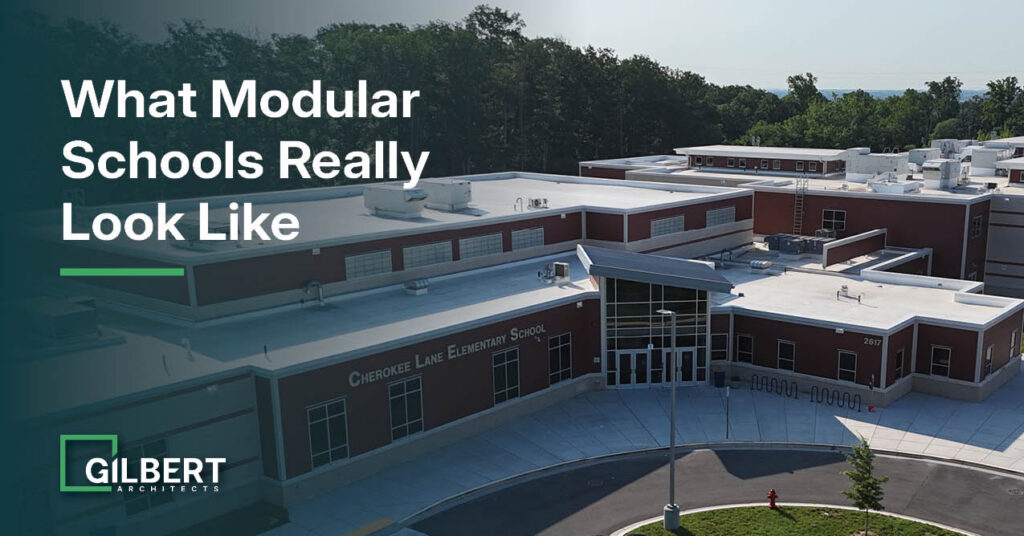
If you ask someone what modular construction looks like, you’ll often hear the same answer:
A beige portable classroom behind the gym.
That image has stuck around for decades.
But permanent modular construction, also called off-site manufactured construction, has evolved dramatically. Today it’s being used to deliver entire school buildings, classroom wings, and complex additions, often faster and with less disruption to students.
And once the building is complete, most people can’t tell the difference.
1. It looks like a real school building
One of the biggest misconceptions about permanent modular construction is that the finished building somehow “looks modular.”
It doesn’t.
Permanent modular schools today include:
- multistory classroom wings
- media centers and collaborative learning spaces
- science labs and spaces for specialized programs
- administrative offices and secure entrances
Once the modules are installed and the exterior is finished, the building is virtually indistinguishable from traditionally constructed schools.
Architecturally, school districts and systems still have full freedom to pursue:
- daylight-filled classrooms
- flexible learning environments
- durable materials
- modern security design
- energy-efficient systems
The result is real architecture, not temporary space.
2. It looks like a predictable, reliable schedule
Conventional construction happens in sequence.
First the site is prepared.
Then the structure goes up.
Then interior construction begins.
With modular construction, much of the building is constructed at the same time the site work is happening.
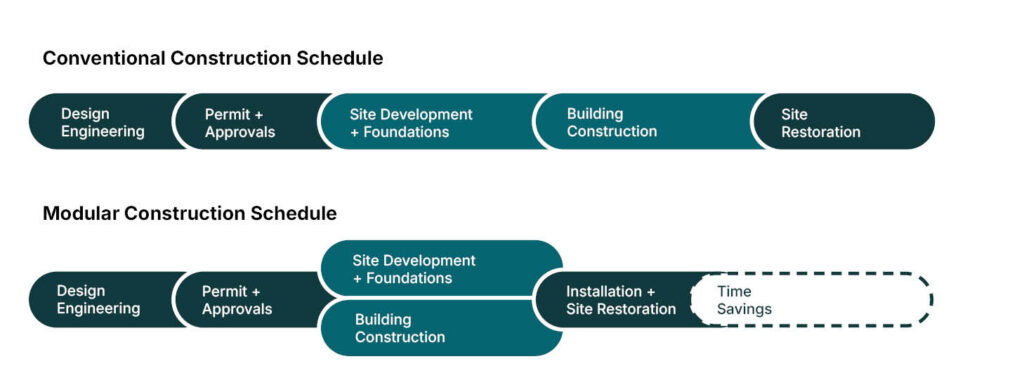
While foundations and utilities are installed, building modules are being fabricated in a controlled facility. In many projects, entire classrooms arrive on site already wired, finished, and tested.
This parallel process can significantly compress schedules.
For schools, that often means:
- opening buildings on time for the school year
- reducing reliance on temporary classrooms
- minimizing weather delays
- delivering facilities faster when enrollment demands change
3. It looks like a calmer, more manageable jobsite
Construction on an occupied school campus is complicated.
There are safety concerns, noise impacts, traffic issues, site storage concerns, and constant coordination with school schedules. Because a large portion of modular construction happens off site, the amount of work happening on campus is dramatically reduced.
That means:
- fewer deliveries
- fewer workers on campus
- less noise during the school day
- fewer material storage requirements
- shorter on-site construction timelines
For school districts and systems building additions or renovating occupied schools, that reduction in disruption can be a major advantage.
4. It looks like built-in quality control
Factory-built construction introduces a level of consistency that can be difficult to achieve on a traditional jobsite. Inside a controlled manufacturing environment:
- materials are protected from weather
- construction sequences are repeatable
- inspections occur at multiple stages
- precision equipment improves accuracy
- systems are highly coordinated
This doesn’t replace skilled trades; it simply moves part of the process into a more controlled environment.
For districts investing in facilities that will serve communities for decades, that predictability is valuable.
5. It looks like precision manufacturing
One of the most overlooked aspects of permanent modular construction is where much of the work actually happens.
Instead of building entirely outdoors, many components are constructed inside a manufacturing facility. Inside the factory, teams assemble modules that include:
- framing and structural components
- electrical and plumbing systems and fixtures
- drywall and interior finishes, including ceramic tile
- flooring and ceiling systems
- casework, marker boards, tack boards, windows, and blinds
In many cases, classrooms arrive on site already wired and finished, with only mate line finishes—the seams where modules connect—and low-voltage wiring left to complete.
Because this work happens indoors, the process benefits from:
- consistent working conditions
- specialized crews performing repeatable tasks
- multiple inspection points and testing throughout production by qualified third-party testing agencies
This manufacturing approach can lead to greater precision, consistency, and highly coordinated systems.
6. It often looks like a hybrid approach
Perhaps the most important thing to understand about modular construction is this:
It rarely replaces conventional construction entirely.
Many of the most successful school projects today use a hybrid approach, combining modular and site-built components. For example:
- classroom wings built modularly
- gymnasiums constructed traditionally
- cafeterias built on site
- administrative areas built off site
This allows districts to use modular where it makes sense, while still maintaining design flexibility.
It’s not an either-or decision.
It’s simply another way to deliver schools efficiently.
Where modular construction makes the most sense
Modular construction can be particularly effective for:
- classroom additions
- rapidly growing school districts and systems
- fast-track projects
- phased construction on occupied campuses
- schools needing space quickly
- projects with limited laydown area or tight sites
Every project is different, which is why early decisions and planning are critical.
When modular is considered during the design process, it can unlock opportunities for schedule savings, reduced disruption, and efficient construction.
Frequently asked questions about modular school construction
Are modular school buildings permanent?
Yes. Permanent modular buildings are designed to meet the same building codes, safety standards, and lifespan expectations as traditionally constructed schools.
Is modular construction faster than traditional construction?
Often, yes. Because site work and building fabrication happen at the same time, many modular projects can be delivered significantly faster than traditional construction schedules.
Can modular school buildings be multistory?
Yes. Modern modular school buildings can include two or more stories depending on the design and site conditions.
Is modular construction cheaper?
Not always. The biggest benefits are often schedule savings, reduced disruption to campuses, and improved construction efficiency.
Common misconceptions about modular schools
Despite its growth, modular construction is still surrounded by a few persistent myths.
“Modular buildings are temporary.”
Permanent modular schools are designed to meet the same building codes and longevity expectations as traditional construction and can even be more durable as they are designed to withstand transportation to the project site.
“Design options are limited.”
Modern modular projects can incorporate a wide range of architectural styles, materials, and layouts. The main limitation is designing the modules so they can be shipped to the project site.
“Modular means lower quality.”
In many cases, factory construction actually allows for tighter quality control and refined systemic coordination because work happens in a controlled environment.
For many schools, the biggest surprise is simple:
Once the building is finished, you can’t tell it’s modular.
The bigger picture
Modular construction isn’t a silver bullet.
And it isn’t replacing traditional construction.
Instead, it’s becoming part of a broader toolkit for delivering schools more efficiently.
The districts seeing the most success are the ones asking a simple question early in the process:
Where does modular make sense for this project?
When used strategically, off-site construction can deliver high-quality learning environments faster, while still achieving the design, durability, and flexibility communities expect.
If you’re exploring facility improvements or additions, it may be worth evaluating whether off-site construction could be part of the strategy.